Acclaim Voice AI Platform shaves off 84%* of latency in live conversations with its patent-pending Smart End-of-Sense Predictor
As businesses are rushing into agentic AI automation of their communication-heavy operations, one of the main goals claimed by the industry is to deliver human-like conversational experiences.
Enterprises usually chase these four things:
- a voice that doesn't sound robotic,
- a natural conversational dynamic,
- the right emotional tone,
- on-brand/compliance guardrails.
Achieving all four is not just complex — it involves trade-offs. For example, the speed with which the agent reacts to what is said is exactly what makes its speech human-like, but it is also the very characteristic to be traded off for compliance.
Current conversational systems that are fast are also often less controlled, which is a huge blocker for any regulated industry enterprise. For the most part, it is either “think longer before speaking and stay compliant” or “answer fast and come what may”.
The Acclaim tech team tackled the issue by developing a technique that helps our model do both: communicate at natural speed, while being fully in control of what is actually said to a customer, and why. We call this technique the Smart End-of-Sense Predictor.
The “slow thinker” problem or why voice AI pauses before it answers
A conventional voice agent waits for the customer to finish their sentence, then processes it, then composes an answer, and only then speaks. Every step waits for the one before it – and the customer sits through roughly two seconds of silence. If a human behaved this way, a call center would not be the obvious career choice for them.
This is vastly different from how humans interact. When one side of the conversation is a human being and the other one is an AI agent – human impatience ruins the flow. The moment the pause feels awkward, a typical human will ask again – “Did that make sense?”, “Did you hear me?” – adding to the load the AI agent is already processing.
The whole exchange feels unnatural and frustrating for the customer, it contradicts the point of the whole system, and it sends the enterprise's investment down the drain.
How to make AI grasp it on the fly? How the Smart End-of-Sense Predictor works
Our approach lets the agent recognize where the customer's request is going while they are still speaking, and begin preparing the response in the background – just like humans do. Take a customer who says: “Okay then, I’m ready to apply for a mortgage, even though I’m not sure how much I need yet.” The intent is clear well before the sentence ends. The moment our predictor detects that the meaning is complete, the system starts generating the response and checking it against compliance requirements. So by the time the person has finished speaking, we're already ready to deliver the answer. Built-in safeguards keep the agent from acting on an incomplete thought or talking over the customer.
Now compare to “Okay, I think I'm ready to apply for the card, although I'm not sure what credit limit is right for me”. Both parts of the sentence are equally important, and Acclaim’s Smart End-of-Sense Predictor detects this – ensuring no important information gets lost.
The result is a response gap of roughly 300 milliseconds instead of ~1.9 seconds – inside the range of natural human conversation.
Let’s take a closer look at how this unfolds in a real-life conversation
Let’s say your Voice Agent speaks to a customer about their mortgage loan and the person answers:
“Okay then, I’m ready to apply for a mortgage, even though I’m not sure how much I need yet”
In the traditional approach, the Speech-to-Text module detects the End-of-Utterance event (usually defined as a 0.8-1 seconds pause on the user's end) before passing the phrase for further processing. This adds 800 ms to latency. With 1000 ms for generating the answer itself and another 100 ms for speech synthesis, we are looking at 1900 ms (almost 2 seconds) between the customer's last word and the agent's first. Quite robotic.
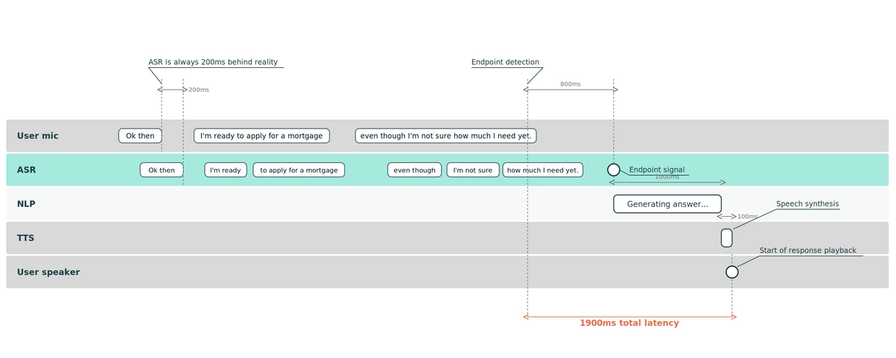
If we look at the phrase closely, we find that sufficient information for generating the answer was actually articulated earlier in the sentence:
“I’m ready to apply for a mortgage”.
What if we could start generating right after this was said? This way, while the rest of the phrase is still being articulated by the person, the answer is already being generated in the background. What is left to do is to detect the actual end of the phrase, confirm that the meaning was captured correctly and synthesize the speech.
The Acclaim team added several checkpoints throughout the process:
SED: Speculative Endpoint Detector. An optimistic audio-based detector with rollbacks. Detects pauses and continuously checks if the speech has ended.
“Okay then, [endpoint signal] I’m [endpoint rollback signal] ready to apply for a mortgage, [endpoint signal] even [endpoint rollback signal] though I’m not sure how much I need yet [endpoint signal]”
The endpoint rollback signal protects the user from receiving wrong replies. When a user pauses, the endpoint signal fires. If the pause turns out to be very brief and the user keeps speaking, the endpoint rollback signal fires to cancel that endpoint.
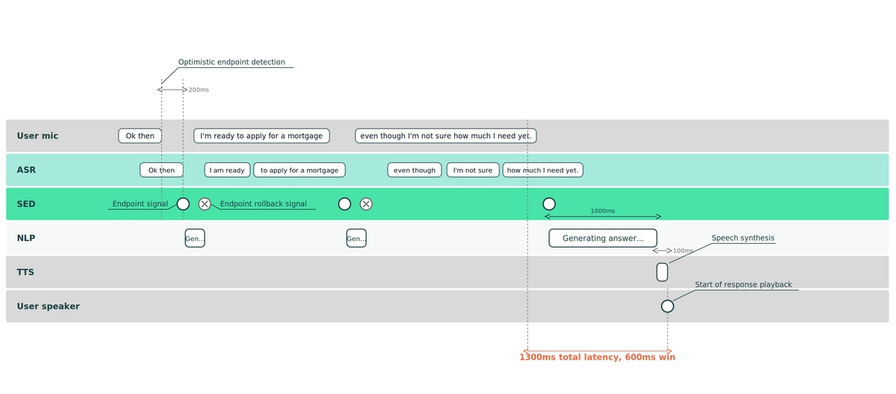
ISD: Intent Sufficiency Detector. A text-based end-of-sense detector analyzes whether what has been said so far is enough to start generating the answer, even if the user is still speaking.
“Okay then, [endpoint signal] I’m [endpoint rollback signal] ready to apply for a mortgage [endpoint signal] [ISD Endpoint signal, guards NLU cancellation], even [endpoint rollback signal] though I’m not sure how much I need yet [endpoint signal]”
Once meaning is captured, NLP starts generating the answer.
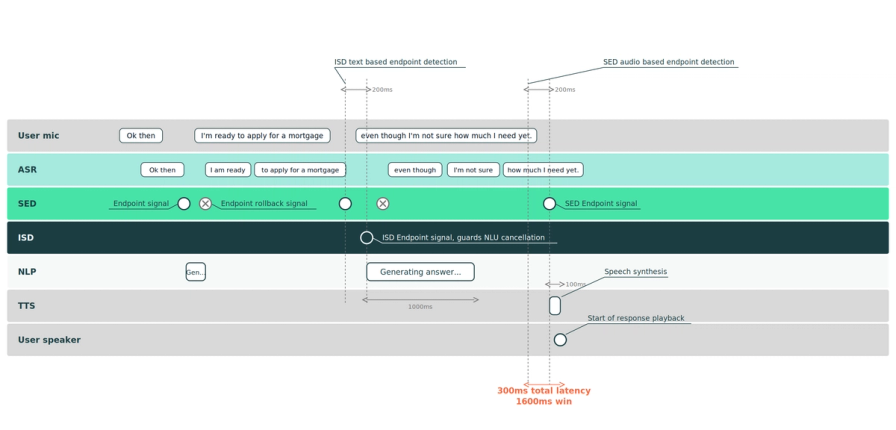
Smart End-of-Sense Predictor runs the response flow as several parallel processes as the customer speaks, triggers NLP earlier in the process, shaving up to 1600 ms off the overall latency, reducing it to a mere 300 ms – a gap almost indistinguishable from human speech.
What 300ms latency means for your business
Fewer drop-offs. The robotic pause is the moment customers realize they're talking to a machine – and often the moment they disengage. Natural timing keeps them in the conversation.
Speed doesn't cost you compliance. Every response still passes the same guardrails and remains fully traceable and auditable. Faster is not looser – which is what makes this deployable in collections, banking, and fintech rather than just in low-risk use cases.
Better completion on complex flows. Applications, verifications, payment arrangements – multi-turn conversations are where latency compounds. Removing it is what makes longer flows finishable.
Voice and tone are table stakes now. Timing is the differentiator – and it's the one most platforms still can't solve.
*based on Acclaim’s internal testing data