The AI Confidence Gap: how financial services leaders in the UK and US are really deploying AI
We asked 510 people working in financial services across the UK and the United States how far AI has actually got inside customer operations. Nine in ten told us regulatory uncertainty has delayed or limited their deployment. Ninety-six percent said they would move faster if they were confident they could meet every requirement. And while 94% believe they are ready for regulatory scrutiny, only 37% say their AI outputs are fully traceable and auditable.
Research conducted by Censuswide for Acclaim. Sample: 510 practitioners and leaders at banks, neobanks, credit unions and buy-now-pay-later providers in the US and UK.
The short version
- 91% say regulatory uncertainty has delayed or limited their AI deployment, and 46% call the delay significant.
- 97% say data residency or data sovereignty has influenced their choice of AI vendor – 65% say significantly.
- 96% would deploy faster with full confidence in regulatory compliance. For 58%, regulation is not one bottleneck among several; it is the bottleneck.
- Only 30% have AI widely deployed across multiple functions.
- 94% believe they are prepared for increased AI-specific regulatory scrutiny – but only 37% say AI outputs are fully traceable and auditable.
- 7.7 months is the average time from AI vendor selection to production.
- 33% say AI has clearly paid for itself.
Taken together, those last three say something uncomfortable. Stated readiness is close to universal. The ability to evidence what a system did is not. Whatever else is slowing this market down, the gap between the two is worth any executive team's attention.

Half have reached production. Half have not.
Thirty percent of respondents say AI is widely deployed across multiple functions. Another 21% have it in a limited number of use cases. That leaves 49% short of production: 29% piloting or testing, 20% with initiatives planned but not yet implemented.
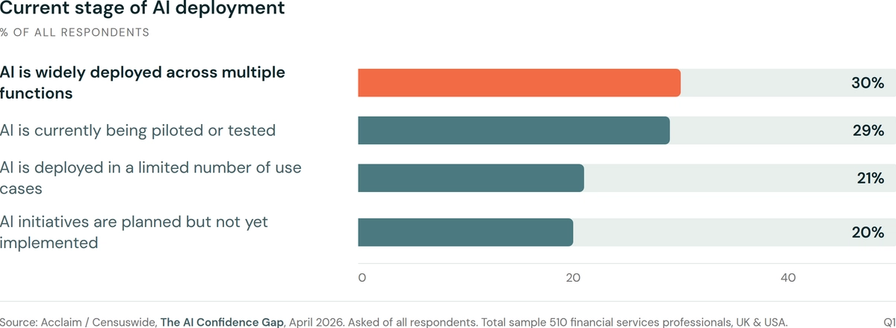
The split runs along national lines. Just over a quarter of UK respondents (26%) say AI initiatives are planned but not yet implemented, against 1 in 6 (16%) in the US. Bank respondents are more likely than neobank respondents to report wide deployment (32% vs 23%) – which cuts against the assumption that the newer institutions are further ahead.
Where AI is being deployed or evaluated is revealing in its own way: nothing clears 40%.
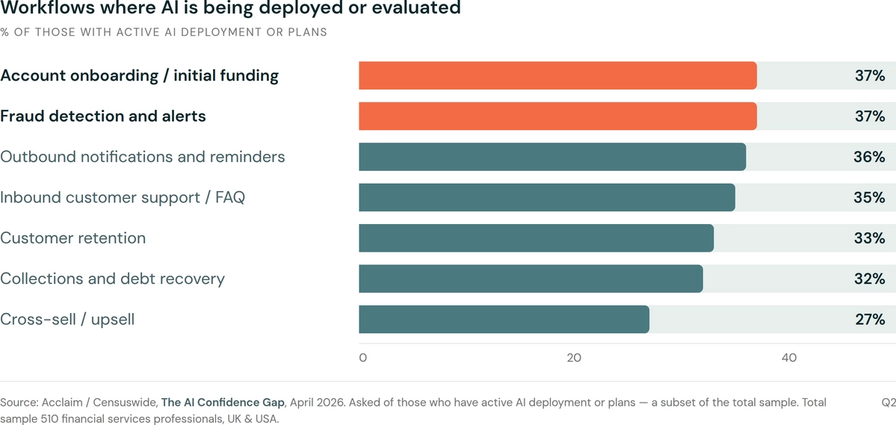
Account onboarding and fraud detection lead on 37%, followed by outbound notifications (36%), inbound support (35%), retention (33%) and collections (32%). US respondents are markedly more focused on retention than UK ones (39% vs 25%). Credit union respondents are more likely than neobank respondents to be working on outbound notifications and reminders (40% vs 26%).
On strategic posture, no single attitude wins. Twenty-three percent describe their organisation as aggressively pursuing AI innovation; 22% are moving steadily but cautiously; 21% are prioritising compliance over AI expansion; 20% are taking a wait-and-see approach due to regulation. Fifteen percent say AI adoption is not currently a strategic priority at all.

Finance pushes hardest. The board decides.
Ask where the internal push for AI is coming from and the answer is not the technology function. Finance teams lead on 25%, ahead of the board and executive leadership (23%). Technology teams and customer experience teams tie on 18%, innovation teams on 16%.
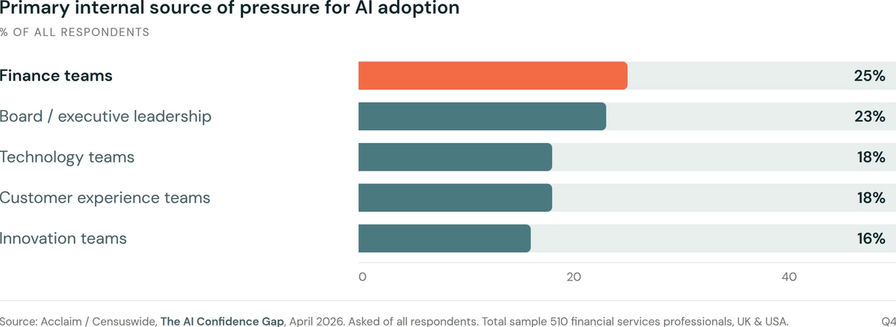
At neobanks the finance signal is far louder: 36% name finance teams, against 24% at credit unions and 23% at banks.
Decision authority sits higher still. Thirty-one percent name the CEO or board as the most influential voice on AI in customer operations – nearly double the COO at 17%, with the CIO/CTO and the CFO tied on 15%.
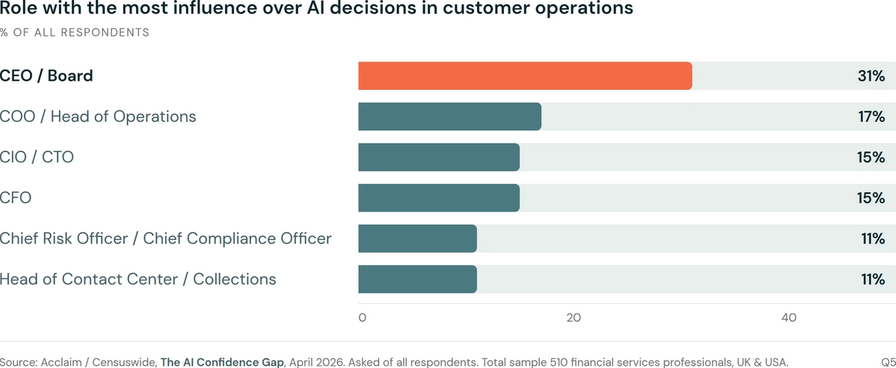
UK respondents concentrate that authority even further: 36% name the CEO or board, against 27% in the US.
The practical consequence for anyone selling into this market is that the business case has to survive a finance review and read well in a board paper. The survey does not tell us what wins a deal – but it does tell us who is in the room.

Fraud and collections top the three-year outlook
Asked where they believe AI will have the greatest impact over the next two to three years, respondents put fraud detection and prevention and collections and debt recovery jointly first, both on 35%. Proactive outreach and predictive service follows on 34%, with customer onboarding and verification and agent assist and workflow automation tied on 33%.
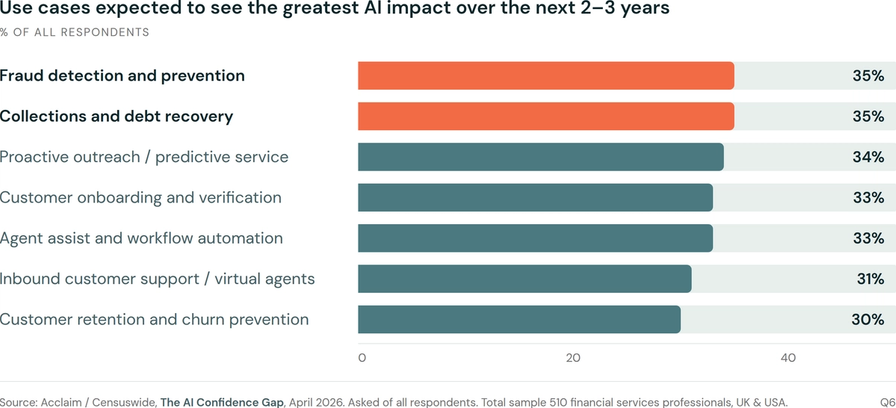
Collections is notably more prominent among UK respondents (40%) than US ones (32%). Fraud splits hard by institution type: 39% of bank respondents name it, against 18% at credit unions.
Then there is the clock. The average time from AI vendor selection to production deployment is 7.7 months. Thirty-nine percent report 7–12 months, 38% report 3–6, and 16% report more than a year.
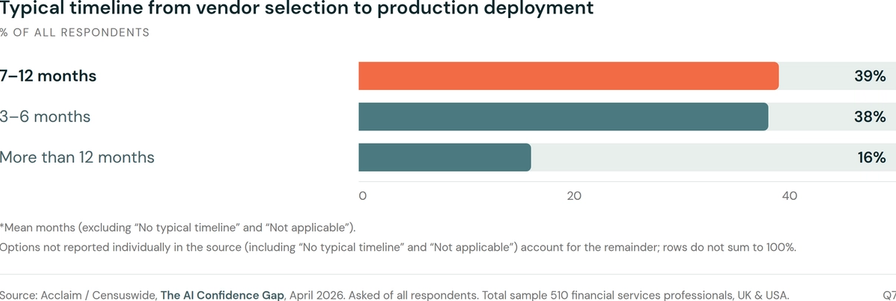
UK respondents are more likely to report timelines over a year (22% vs 13%). Bank respondents are the most likely to report 3–6 months (45%), ahead of neobanks (29%) and credit unions (22%).

Two anxieties, pulling in opposite directions
We tested two statements. Both landed hard, and they point opposite ways.
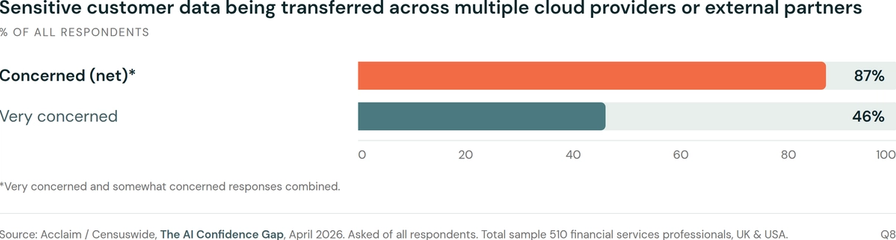
Eighty-seven percent are concerned about sensitive customer data being transferred across multiple cloud providers or external partners, with 46% very concerned.
Eighty-six percent are concerned that slower AI adoption could disadvantage them against competitors, with 39% very concerned.
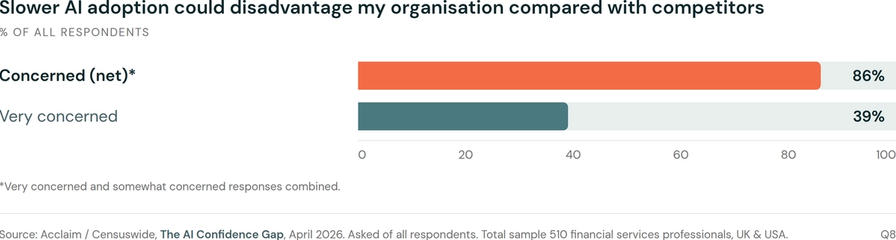
UK respondents report both more strongly: 91% are concerned about data transfer against 84% in the US, and 47% are very concerned about falling behind, against 34% in the US. Bank respondents are the most worried about data movement – 49% very concerned, against 27% at credit unions.
Two pressures, roughly equal in size, pointing in opposite directions. Whether they sit inside the same heads is something this survey cannot tell us; what it does show is that both are close to universal across the sample.

A third can show a clear return. A fifth cannot tell either way.
Thirty-three percent say AI has clearly paid for itself and is generating positive returns. Twenty-seven percent see early positive signals but no full payback yet. Twenty-one percent say ROI is unclear because they lack the metrics or data to assess it properly. Eighteen percent say AI has not delivered the returns they expected.
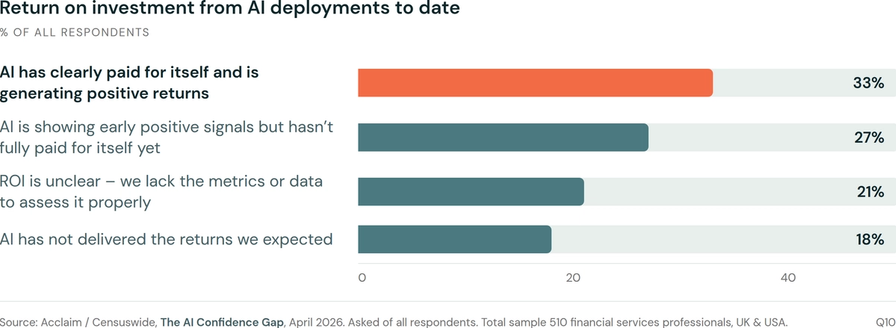
Read the 21% carefully. That group is not reporting failure – it is reporting an absence of evidence. A quarter of neobank respondents fall into it (25%), against 21% at banks and 15% at credit unions.
What gets measured is tightly bunched. Business outcome achievement and customer satisfaction scores tie at the top on 36%, followed by agent handle time reduction, compliance incident reduction and first-contact resolution rate, all on 34%, then call completion rate (32%) and cost per interaction (28%). UK respondents weight compliance incident reduction more heavily than US ones (38% vs 31%).
And when we asked what has most limited ROI, no single blocker dominated:
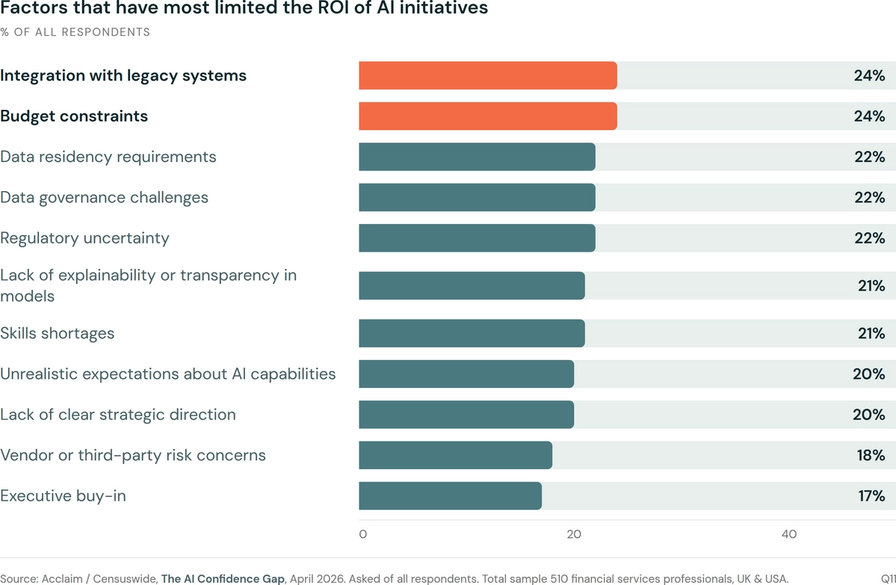
Eleven factors cluster between 17% and 24%. Integration with legacy systems and budget constraints lead on 24%; data residency requirements, data governance challenges and regulatory uncertainty follow on 22%. US respondents cite legacy integration more often than UK ones (27% vs 20%).
The shape of that chart matters more than its ranking. There is no single thing to fix. The drag is cumulative – and budget is still part of it.

Nine in ten have been slowed by regulation. More than nine in ten say they are ready for it.
This is the sharpest tension in the data.
Ninety-one percent say regulatory uncertainty has delayed or limited their AI deployment, and 46% say it has delayed or limited it significantly. Only 1 in 11 report no noticeable impact.
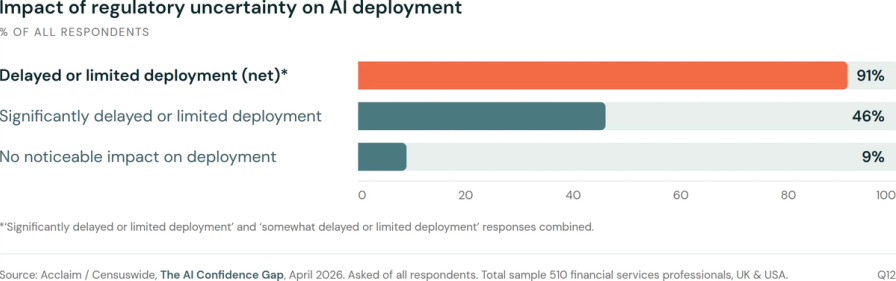
The UK figure is close to universal: 98% of UK respondents report a delay, against 86% in the US. Among institution types, neobanks are most affected (94%), then banks (91%), then credit unions (84%).
Now look at what organisations say they can actually show. Ninety-one percent say AI outputs are traceable in their organisation — but that breaks down as 54% mostly traceable with some limitations and only 37% fully traceable and auditable. Nine percent report limited traceability today.
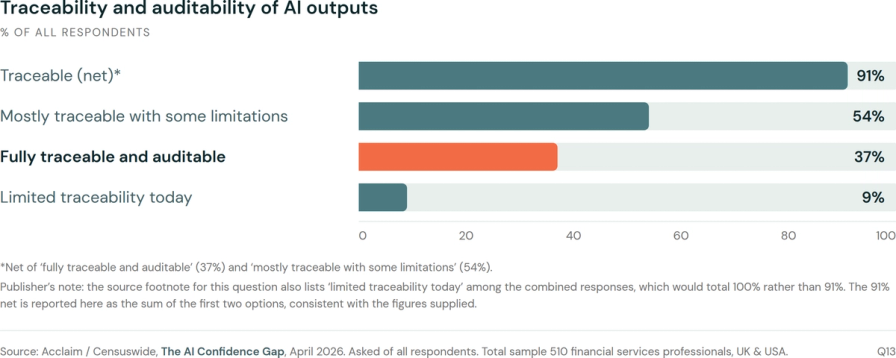
Hold that 37% in mind, because the next answer sits oddly beside it. Ninety-four percent believe their organisation is prepared for increased AI-specific regulatory scrutiny over the next two to three years — though only 43% say very prepared. Ninety-six percent say they are prepared to comply across multiple states or global markets, with 47% very prepared.
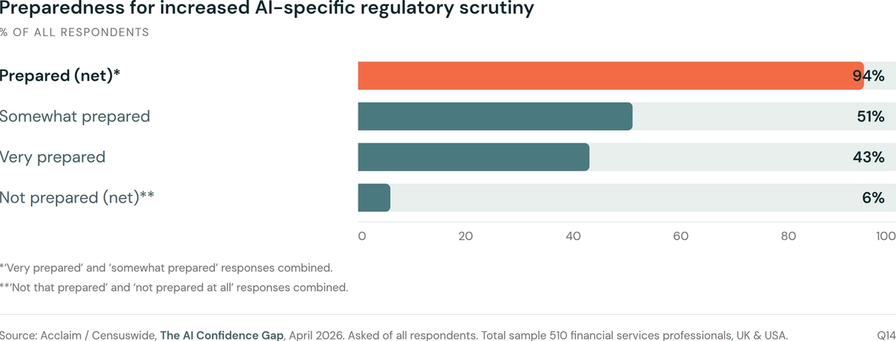
So the section ends where it started – on a gap. Ninety-four percent feel ready for scrutiny; 37% report that they can fully evidence what their systems did. At the level of the market the distance between the two is the finding. Both numbers are self-reported, which if anything makes the 37% the more striking of the pair: it is an organisation's own account of its audit trail, not an external assessment of it.

Ninety-seven percent say data residency or data sovereignty has influenced their choice of AI vendors or platforms. Sixty-five percent say it influenced that choice significantly; 32% somewhat.
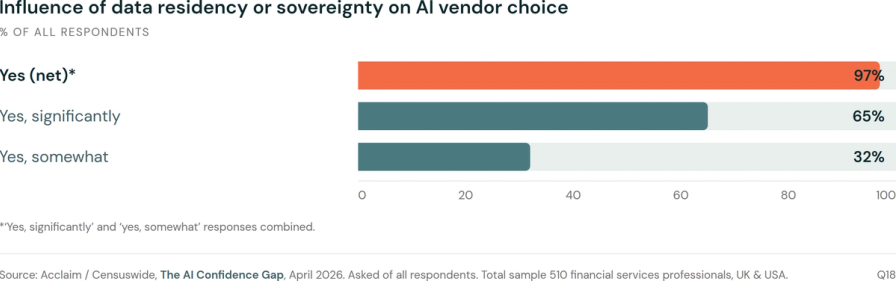
That is the single highest net figure in the study. Neobank respondents are the most emphatic: 72% say significantly, against 55% at credit unions.
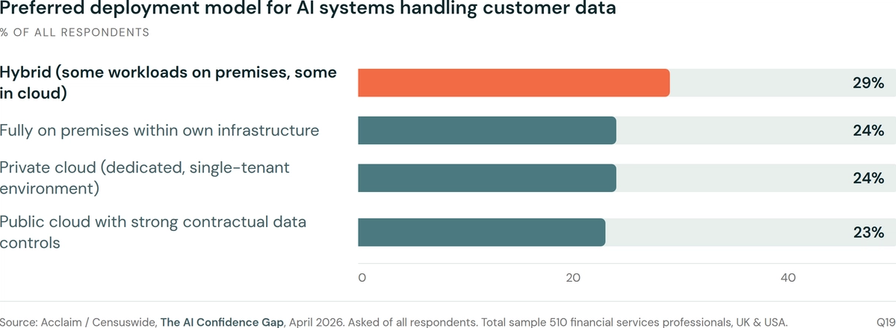
It shows up in architecture preferences too. Hybrid leads on 29%, but no model clears 30% – fully on-premises and private cloud tie on 24%, public cloud with strong contractual controls takes 23%. US respondents prefer hybrid more than UK ones (32% vs 25%); a third of credit union respondents (33%) want fully on-premises.
Part of the reason is visible in the supply chain. On average, respondents report four third-party vendors handling or receiving their customer service data, and, separately, four vendor sub-processors doing the same.
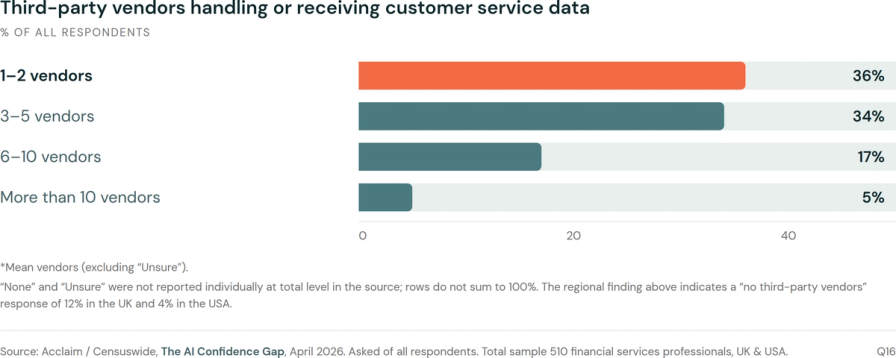
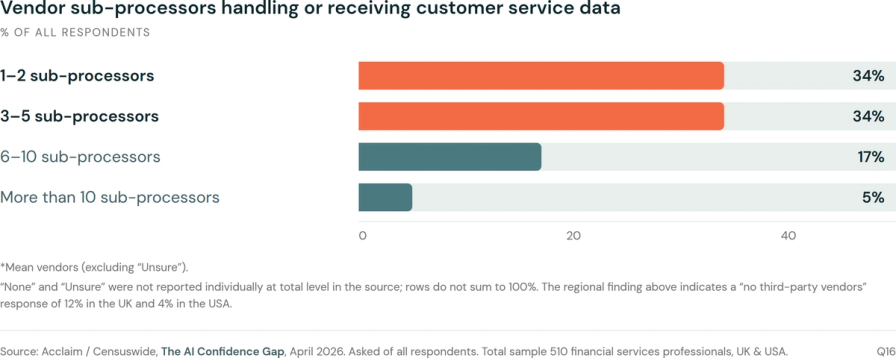
Each one of those is a place customer data goes and a place it has to be accounted for. Set that against the stated confidence: 88% are confident they know where their customer service data resides across their AI ecosystem, 85% are confident third-party AI vendors fully meet their regulatory obligations, and 85% are confident they could clearly explain how their AI systems work to a regulator if required. US respondents are consistently more confident than UK ones – 49% vs 40% very confident that they know where their data resides.
Which brings us to the number this whole study turns on.
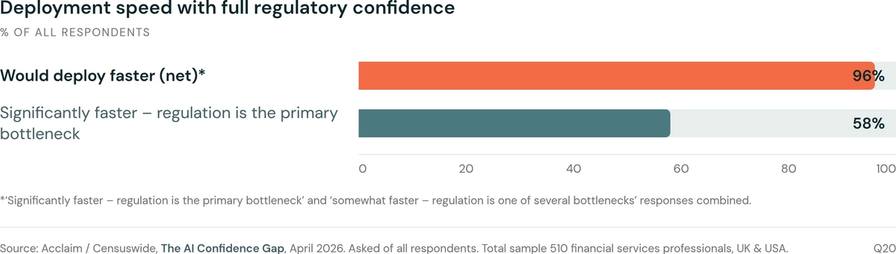
Ninety-six percent would deploy AI in customer-facing operations faster if they had full confidence they could meet every regulatory requirement. Fifty-eight percent would deploy significantly faster, because regulation is the primary bottleneck rather than one of several. Bank respondents are more likely to say so than neobank respondents (60% vs 51%).
What this suggests if you are buying AI in 2026
Four things follow from the data. Most of them are procurement questions rather than technology ones.
Ask vendors to show traceability, not state readiness. Ninety-four percent of this sample believe they are prepared for scrutiny; 37% report full traceability. Whichever side your own organisation is on, the question that separates the two is not "are you compliant" but "show me the audit trail for a single interaction, end to end".
Count the processors. Four third-party vendors on average, and four sub-processors. Every additional party is another transfer to document, another contract to align and another seam between systems where accountability can slip. A shorter chain is a compliance asset.
Treat residency as an architecture decision, not a contract clause. Ninety-seven percent say it has influenced vendor choice. On deployment model, 29% want hybrid, 24% fully on-premises and 24% private cloud – on our calculation, 77% prefer a model that keeps at least some workloads off public multi-tenant cloud. Where the model runs is now part of the specification.
Write the business case for the people who will read it. Finance teams are the single largest source of internal pressure (25%) and the CEO or board holds the most influence over the decision (31%). The survey does not say what persuades them – but it is clear whose questions the case has to answer.
Key takeaways
- Only 30% have AI widely deployed; 49% are still piloting or planning.
- 91% have been delayed or limited by regulatory uncertainty, and 58% call regulation the primary bottleneck rather than one of several.
- Stated regulatory readiness (94%) runs far ahead of reported full traceability (37%).
- Data residency or sovereignty has influenced vendor choice for 97% of respondents – significantly, for 65%.
- On average, four third-party vendors and four vendor sub-processors touch respondents' customer service data.
- A third of respondents can point to a clear return on AI; a fifth say they lack the metrics to tell either way.
- Fraud detection and collections are where respondents expect AI to have the greatest impact over the next two to three years, both on 35%.
- UK respondents report slower timelines and higher concern; US respondents report faster deployment and higher confidence. Both groups land on the same constraint.
Methodology
Censuswide surveyed 510 respondents who work in the financial sector – banks, neobanks, credit unions and "buy now pay later" providers – across the UK and the USA.
Respondents were practitioners (Directors, Heads and VPs of Customer Operations, Customer Experience and Customer Success) and leadership (CEO, COO, CFO, CTO, CCO, Chief Digital Officer, Chief AI Officer, and Heads of CX, Collections and Call Center).
Fieldwork ran from in April 2026.
Where a figure is described as a "net", it combines the response options named in the note to that question. Percentages are reported as supplied by Censuswide and may not sum to 100 due to rounding or multi-select questions. Any net or subtotal calculated by Acclaim rather than supplied by Censuswide is identified as such in the text.
Censuswide abide by and employ members of the Market Research Society, which is based on the ESOMAR principles, and are members of The British Polling Council.
How to cite this research: Acclaim, The AI Confidence Gap: How financial services leaders in the UK and US are really deploying AI in customer operations, 2026.
Research conducted by Censuswide, H1 2026, among 510 financial services professionals in the UK and USA.
The full report covers all twenty survey questions, with UK/US, institution-type and organisation-size breakdowns.