Why AI Gets Harder at 5,000 Employees — And Again at 25,000
Bigger firms should be better at AI. More budget, more engineers, more governance staff. Our research with 510 financial services leaders across the UK and US found the opposite, and the failure isn't gradual. It clusters at two specific points.
The first wall: around 5,000 employees
Below 5,000, regulation barely registers. Among firms with 1,500–2,499 employees, 27% say regulatory uncertainty had no noticeable impact on their AI deployment. At 2,500–4,999, it's 18%.
Cross 5,000 and that number collapses to 5% and stays there. Regulation stops being a consideration and becomes a constant.
Vendor sprawl peaks at exactly the same point. Firms with 5,000–9,999 employees report 4.6 third-party vendors plus 4.7 sub-processors handling customer service data — roughly nine external entities, against an average of 7.6. Nearly 12% have more than ten sub-processors alone.
Deployment breadth falls too. Only 21% of firms in this band say AI is widely deployed across multiple functions, against 38% just below the threshold.
This is the band where AI stops being a project and starts being an estate.
The second wall: around 25,000 employees
The first wall is operational. The second is a confidence collapse, and it's sharper.
Among firms with 25,000–49,999 employees:
- 34% are not confident their third-party AI vendors meet regulatory obligations (15% overall)
- 26% are not confident they could explain their AI systems to regulators (15% overall)
- 22% are not confident they know where their customer data resides (12% overall)
That last one deserves reading twice. One in five leaders at firms this size cannot say where their customer data sits.
These are also the slowest deployers, averaging 8.6 months from vendor selection to production against 7.7 overall.
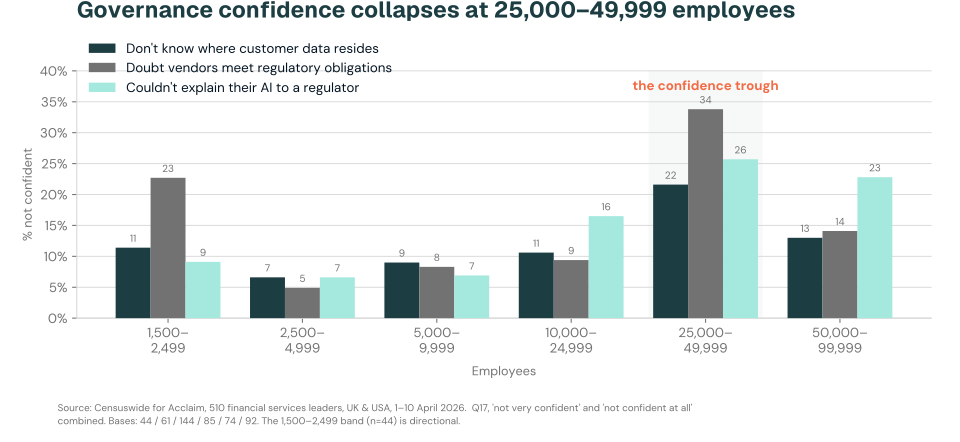
Note what doesn't happen here: vendor counts have already come back down, to 3.0 vendors and 3.4 sub-processors. Complexity peaked twenty thousand employees earlier. The confidence problem arrives after the sprawl, not with it.
Above 50,000, it shows up in the numbers
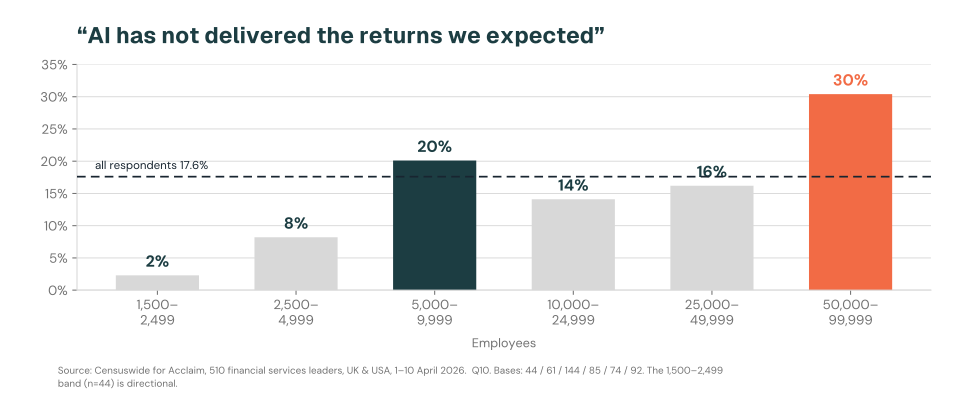
The largest firms in our sample post the worst returns. 30% say AI has not delivered the returns they expected — nearly double the 17.6% average, and more than triple the 8% reported by firms with 2,500–4,999 employees.
Only 26% say AI has clearly paid for itself. And 11% admit they're not prepared for AI-specific regulatory scrutiny, against 6% overall.
Where AI actually works best
Two bands outperform.
2,500–4,999 employees. 38% widely deployed. 61% get from vendor selection to production in three to six months, against 38% overall. Only 8% say AI failed to deliver. Just 5% say AI isn't a strategic priority, against 15% overall. And 49% say the CEO or board holds decision authority — small enough that one person can still clear the path.
10,000–24,999 employees. The highest rate of clear ROI in the study at 40%, and the highest traceability at 45% fully auditable. Large enough to fund governance properly, not yet large enough to have lost track of the estate.
What to take from this
If you're approaching 5,000 employees, your constraint is about to shift from capability to vendor topology. Count your sub-processors before you add another tool.
If you're past 25,000, the gap isn't technical. It's that nobody can answer a regulator's question about a system your organisation already runs. That's an inventory problem before it's an AI problem.
And if you're in the 2,500–5,000 range, you currently have a structural advantage over firms ten times your size. It has a shelf life.
Research conducted by Censuswide on behalf of Acclaim among 510 financial services leaders in the US and UK, H1 2026.