Eight Companies Touch Your Customer Data. Can You Name Them?
Ask a financial services leader whether they know where their customer data sits and 88% say yes. Ask the same people whether they worry about that data moving between cloud providers and external partners and 87% say yes to that too.
Both answers are defensible on their own. Together they describe an industry that believes it has visibility and suspects it doesn't.
Two vendor layers, not one
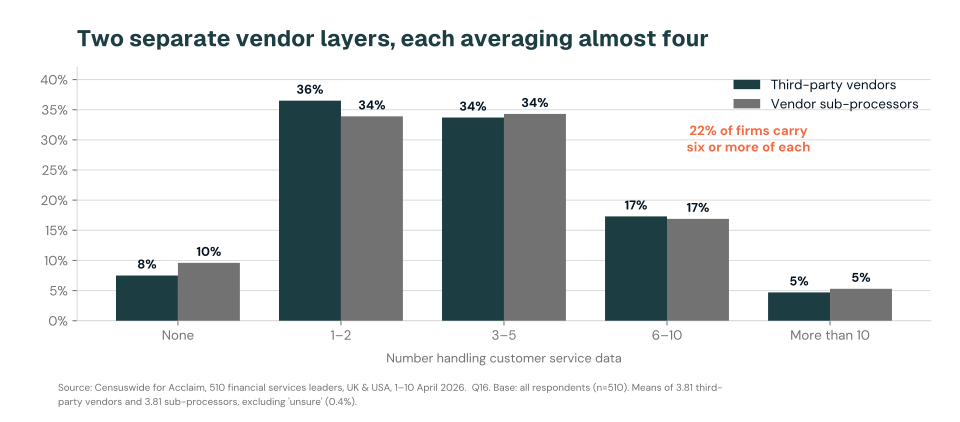
Our research with 510 financial services leaders found an average of 3.8 third-party technology vendors handling customer service data. That number on its own sounds manageable.
It is only half the picture. The same firms report a further 3.8 vendor sub-processors — the suppliers their suppliers use. Combined, that is roughly eight external entities per organisation with a path to customer data.
The distribution matters more than the average. 22% of firms work with six or more third-party vendors, and 22% work with six or more sub-processors. At the top end, 5% are past ten on each count.
Every one of those relationships is a point where data moves, oversight dilutes and accountability becomes a question of contract rather than control.
Which is why location became a procurement question
97% of respondents say data residency or data sovereignty has influenced their choice of AI vendors or platforms. 65% say the influence was significant.
That is close to unanimous, and it reframes what an AI purchase actually is. Capability is table stakes. Where the data sits, and who can reach it, decides the shortlist before a demo is booked.
The concern is well founded. 87% are worried about sensitive customer data being transferred across multiple cloud providers or external partners, and 46% are very concerned. Data residency requirements rank third among all factors limiting AI ROI, named by 22%, just behind legacy integration and budget.
And nobody agrees on the answer
If residency is the deciding factor, you would expect the market to have converged on a hosting model. It hasn't.
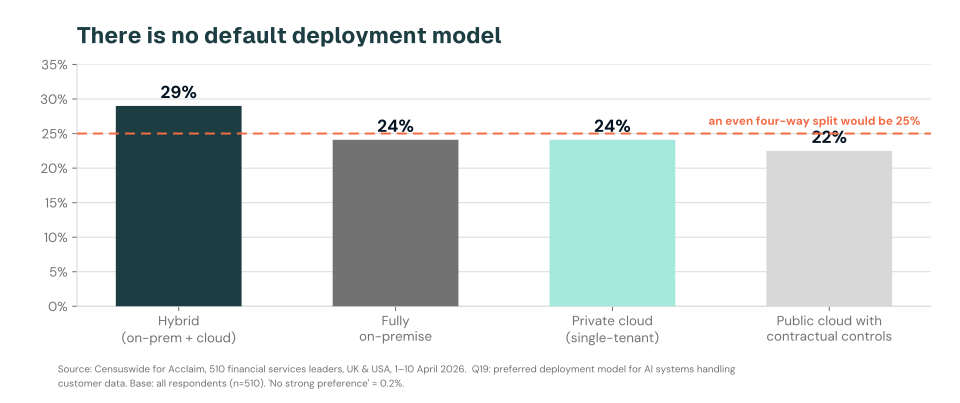
Hybrid leads on 29%, followed by fully on-premise and private cloud tied on 24%, and public cloud with strong contractual controls on 23%. A perfectly even four-way split would be 25% each. The market is within a few points of exactly that.
No default has emerged because the right answer depends on each firm's regulators, data map and risk appetite. Any vendor claiming one deployment model suits regulated financial services is describing their own architecture, not the market's need.
What to do about it
Count the second layer. Most organisations can name their vendors. Far fewer can name their vendors' sub-processors, and that is where the average doubles.
Make lineage a contractual requirement rather than a diligence question. The 88% who are confident they know where data resides and the 87% who worry about it moving are often the same people. Confidence at the point of signature is not the same as traceability at the point of audit.
Treat deployment model as a variable, not a given. A market split four ways is a market where the hosting decision still belongs to the buyer.
Research conducted by Censuswide on behalf of Acclaim among 510 senior decision-makers in financial services across the US and UK, H1 2026.
Read the full report: https://www.acclaim.ai/blog/ai-confidence-gap-financial-services-2026