How Conversational AI Makes Your Contact Center a Revenue Engine
At a glance
- Customers increasingly expect immediate responses, but human support coverage is expensive and limited.
- High-volume, repetitive inquiries are usually the fastest path to automation and operational savings.
- Real deployments combine customer-facing automation with employee copilots.
- Voice is often the channel that makes automation operational, enabling 24/7 service, call routing, and routine task completion.
Changing the CX equation
If a bank wants a path from AI investment to measurable operational impact and revenue, customer support is often a good place to start.
Many contact-center pain points stem from wait times and limited service hours. Customers expect fast answers, yet human staffing models struggle to scale economically.
Conversational AI changes that equation by allowing banks to handle routine inquiries automatically while helping employees resolve more complex issues faster.
Why support breaks at scale
Bank contact centers face two structural challenges.
- First, demand is highly unpredictable. Call volumes can spike suddenly due to marketing campaigns, system outages, fraud alerts, or regulatory changes.
- Second, a large percentage of inquiries are repetitive. Customers call to check balances, reset passwords, confirm transaction status, or ask routine policy questions.
Human agents can only handle one interaction at a time. AI systems can manage many simultaneously—especially in chat channels and increasingly in voice environments.
That difference fundamentally changes the economics of customer service operations.
The winning pattern: customer self-service plus agent assistance
The most effective deployments combine two types of systems.
- Customer-facing assistants handle common requests quickly through chat or voice interfaces. These systems resolve simple inquiries without requiring human intervention.
- Employee-facing copilots support human agents by surfacing relevant policies, account information, or suggested responses during live interactions.
This combination avoids a common failure mode: trying to deflect every interaction away from humans. Instead, banks automate routine work while making human agents faster and more accurate on the interactions that remain.
What it looks like in practice
Several real-world deployments illustrate how this model works.
- Expanding automation across customer conversations: Financial institutions are increasingly automating routine customer interactions to reduce operational pressure and improve responsiveness. With structured conversational workflows and clear objectives, many common service requests can be handled automatically while reserving human agents for more complex interactions.
- Automating routine inquiries: A large share of customer service traffic consists of repetitive requests—balance checks, payment reminders, account updates, and simple support questions. Voice-first AI agents can handle these interactions automatically, removing significant volume from human queues. In one large digital bank deployment, automated outreach increased payment efficiency by roughly10Xand improved secured payments by about3%,proving how structured AI conversations can directly impact recovery outcomes.
- Giving employees an AI copilot: AI copilots can assist employees by answering internal policy questions, retrieving documentation, or guiding agents through procedures during live conversations. Instead of navigating multiple internal systems, agents receive contextual assistance in real time, improving speed and consistency.
- Modernizing the phone channel: Voice remains a critical channel for customer engagement. AI voice agents can handle routine calls, explain account information, and guide customers toward next steps while maintaining natural conversation and consistent compliance at scale.
Together, these changes reflect a broader shift in customer expectations: many customers now prefer resolving simple issues through fast self-service interactions rather than waiting for a human agent.
Where can an enterprise easily pilot conversational AI?
A practical starting point for conversational AI is payment reminder outreach. Why? Because the use case is straightforward, high-volume, and easy to measure. So it’s ideal for early AI pilots. Here's why.
- Structured conversations: Payment reminders follow predictable scripts: confirm identity, explain the balance, and offer options such as paying now or scheduling a payment.
- High interaction volume: Banks, credit unions, fintech firms, telecoms, and utilities send large numbers of reminders each month, making automation immediately impactful.
- Clear success metrics: Performance can be evaluated using simple KPIs such as contact rate, promise-to-pay rate, payment conversion, and cost to collect.
- Safe hybrid escalation: If a situation becomes complex—disputes, hardship, unusual account issues—the conversation can transfer to a human agent.
Since the objective is narrow and measurable, payment reminders give you a controlled environment to validate conversational AI before expanding it into more complex customer interactions.
How Acclaim helps
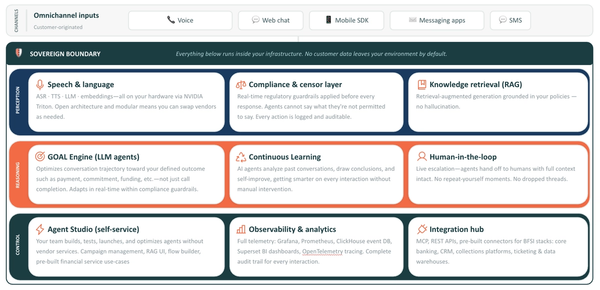
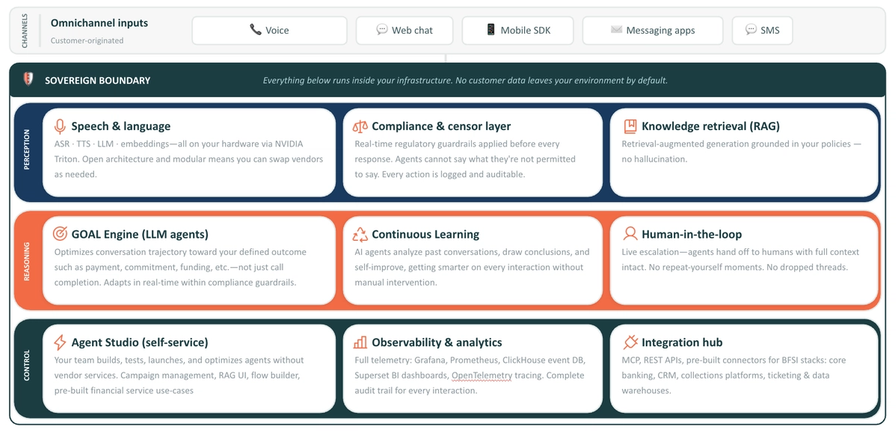
Acclaim enables banks to deploy conversational AI across both customer-facing automation and employee assistance.
Its GOAL-oriented AI agents can resolve common support requests such as account inquiries, payment reminders, and service notifications through voice or chat channels. Because the platform is voice-first, banks can extend support coverage to the phone channel with 24/7 automation.
At the same time, Acclaim’s architecture supports agent assistance workflows that surface relevant information during live interactions, helping employees resolve issues faster and more consistently.
The result is a support model that combines automated self-service with stronger human performance—reducing wait times while improving operational efficiency.