
Guardrails
What are guardrails?
In regulated customer experience (CX) environments, guardrails are the policies, controls, and technical constraints that ensure AI agents consistently achieve defined business outcomes while operating safely, compliantly, and predictably.
Quick definition: AI agent guardrails are built-in business, compliance, and technical boundaries that control how AI agents speak, decide, and act during regulated customer interactions to ensure safe, compliant, goal-oriented outcomes.
Guardrails are not generic content filters. They are business-critical boundaries that shape how AI agents speak, decide, act, and escalate — especially in high-stakes environments like banking, fintech, retail finance, telecommunications, and other regulated industries.
When customer interactions involve payments, personal data, compliance disclosures, or legally sensitive processes, guardrails ensure:
- Conversations stay aligned to approved policies
- Regulatory requirements are enforced
- Customers receive accurate, consistent information
- Escalations occur at the right time
- Business goals are pursued without crossing legal or ethical lines
In short: guardrails protect revenue, customer trust, and brand reputation while enabling AI to perform at scale.
Why guardrails matter in regulated CX
Every customer conversation is an opportunity to create value — or risk.
In regulated industries, poorly controlled AI can:
- Provide incorrect financial information
- Skip required disclosures
- Mishandle vulnerable customer situations
- Violate privacy regulations
- Increase compliance exposure
Guardrails are foundational to deploying AI that:
- Collects payments responsibly
- Resolves service issues accurately
- Books appointments and closes sales compliantly
- Protects sensitive customer data
- Maintains auditability and transparency
In high-volume voice environments, a single mistake can multiply quickly. Guardrails ensure performance at scale without sacrificing trust.
Types of AI agent guardrails in regulated CX
Guardrails operate at multiple levels — strategic, conversational, operational, and technical.
Regulatory and compliance guardrails
These ensure AI agents operate within legal and regulatory frameworks.
Examples include:
- Required disclosures before collecting payments
- Consent verification for recorded calls
- Data privacy handling (PII masking, secure authentication)
- Jurisdiction-specific compliance logic
- Vulnerable customer detection and escalation
In collections environments, AI must respect rules around call frequency, time-of-day restrictions, and hardship protocols. Guardrails encode those constraints directly into agent behavior.
Goal-oriented guardrails
Not all conversations are open-ended. In regulated CX, interactions must accomplish specific business outcomes safely.
Goal-oriented guardrails:
- Define approved objectives (e.g., secure payment promise, reschedule appointment, confirm dispute details)
- Prevent deviation into unapproved advice or financial guidance
- Keep conversations aligned to defined next steps
- Trigger escalation when goals cannot be met safely
This ensures the AI doesn’t just chat — it completes the task within safe boundaries.
Conversational guardrails (voice and behavior)
In voice-first environments, guardrails must account for nuance.
These include:
- Interrupt handling rules
- Tone and empathy constraints
- Multilingual consistency controls
- Prohibited phrasing
- Sensitive topic detection
For example:
- If a customer expresses financial hardship, the AI must shift tone and follow hardship workflows.
- If intent becomes legally complex, the AI must escalate to a human agent.
This protects both compliance and customer experience.
Operational guardrails
These focus on governance and performance control.
Examples include:
- Role-based access control
- Approval workflows for updates
- Versioning and change logs
- Monitoring dashboards
- Real-time performance alerts
- Audit trails for every interaction
Regulated enterprises require visibility into how decisions are made and how agents behave over time. Operational guardrails enable traceability and accountability.
Infrastructure and security guardrails
Security guardrails ensure AI operates within enterprise standards.
These may include:
- On-prem or private cloud deployment
- Data residency controls
- Encryption requirements
- API access governance
- Model selection and routing policies
- Transparent orchestration logic
In regulated CX, trustworthy deployment means guardrails are built into architecture — not layered on after deployment.
Guardrails vs. generic AI controls
Many vendors claim to offer “AI safety” features. In regulated CX, that is not enough.
Generic AI controls focus on content moderation.Regulated CX guardrails focus on business logic, compliance, and measurable outcomes.
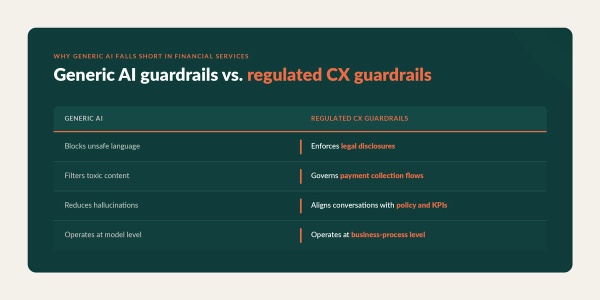
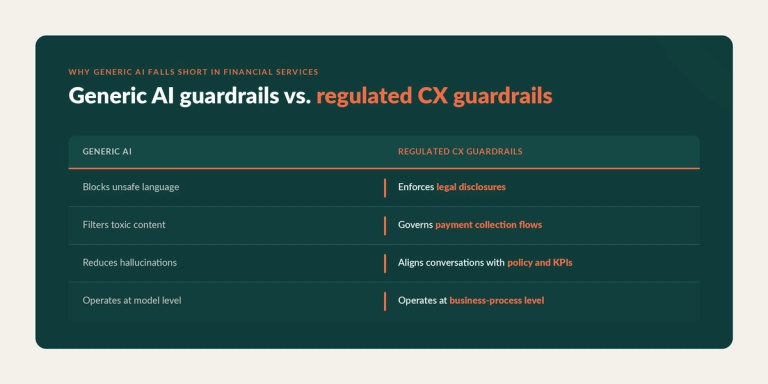
Regulated CX requires guardrails that combine:
- Conversational intelligence
- Policy enforcement
- Defined business goals
- Enterprise governance
What strong guardrails enable
When properly designed, guardrails do not slow AI down. They make it deployable at scale.
Strong guardrails enable:
- Faster approvals from compliance and legal teams
- Safer deployment in high-risk workflows
- Higher completion rates with fewer escalations
- Consistent customer experiences
- Clear audit trails for regulators
- Measurable business outcomes
In enterprise deployments, customers see outcomes such as:
- 10x payment efficiency
- 80% service automation
- 2x improvement in sales performance
These results are sustainable when guardrails are embedded from the start — not retrofitted later.
How guardrails work in a voice-first AI architecture
In voice-heavy regulated environments, guardrails must function in real time.
This requires:
- Voice-first architecture
- Goal-oriented frameworks that embed business objectives
- Workflow orchestration tied to policy
- Escalation logic triggered by intent or risk signals
- Continuous monitoring and improvement
Guardrails are encoded into:
- Conversation flows
- Knowledge retrieval
- Action triggers (e.g., payment processing, CRM updates)
- Escalation paths
- Compliance checkpoints
This ensures every conversation remains aligned to both customer needs and business requirements.
Best practices for implementing AI agent guardrails
For enterprise CX leaders evaluating AI in regulated environments, guardrails should be addressed before deployment.
Key considerations:
- Define business objectives first.
- Identify regulatory requirements by workflow.
- Map escalation triggers clearly.
- Ensure transparency — avoid black-box behavior.
- Require monitoring and audit capability.
- Partner with vendors who build alongside you, not in isolation.
Guardrails are strongest when built in partnership with operations, compliance, legal, and CX leadership.
FAQs
Are guardrails the same as AI content moderation? No. Content moderation is only one small part. Guardrails in regulated CX include compliance logic, business goal enforcement, escalation rules, infrastructure governance, and audit controls.
Do guardrails limit AI performance? No. Proper guardrails increase reliability and completion rates by keeping conversations focused and compliant.
Can guardrails be customized by industry? Yes. Banking, telecom, healthcare support, and retail finance all require industry-specific compliance logic and workflows.
Are guardrails only technical? No. They combine policy design, workflow engineering, model configuration, governance, and monitoring.
Final takeaway
In regulated customer experience environments, guardrails separate experimentation from enterprise deployment.
They ensure AI:
- Delivers measurable business outcomes
- Operates within compliance boundaries
- Protects customers and the brand
- Scales without introducing risk
Without guardrails, AI may talk. With guardrails, AI performs — safely, predictably, and at scale.