
CSAT (Customer Satisfaction Score)
What is CSAT?
Customer Satisfaction Score (CSAT) is a metric that measures how satisfied customers are with a specific experience—such as a support interaction, purchase, or service event—typically using a short post-interaction survey. CSAT captures satisfaction “in the moment,” not long-term loyalty.
Quick definition:
CSAT = the percentage of customers who say they were satisfied (or very satisfied) with a specific interaction or experience.
Why CSAT matters for customer operations
CSAT matters because it’s one of the fastest ways to detect whether changes in staffing, routing, knowledge, automation, policy, or training are improving the customer experience—or degrading it.
Used properly, it acts as an early-warning indicator for churn risk, repeat contacts, and brand damage. Used poorly, it becomes a vanity metric that’s easy to game and hard to operationalize, potentially creating more problems than it solves.
What CSAT includes (and what it doesn’t)
CSAT is a survey-based satisfaction metric defined by your measurement design: what you ask (the question and scale), when you ask it (timing in the journey), and who answers you (the respondent group). In practice, CSAT reports the share (or average rating) of respondents who indicate they were satisfied with a specific interaction, product, or experience within a defined context.
What CSAT typically includes:
- Satisfaction with a specific interaction (call, chat, email, in-app support)
- Satisfaction with a transaction or micro-journey, such as onboarding, payment recovery workflows, issue resolution, or recovery arrangement confirmation.
- Satisfaction with a product/service moment (delivery, refund, claim update)
What CSAT often does not include (or varies by program design):
- Long-term loyalty or advocacy (often better represented by NPS)
- Effort required to get help (often better represented by CES)
- The full end-to-end journey unless you explicitly design the survey for it
- Silent dissatisfaction from customers who do not respond (nonresponse bias)
A crisp way to keep measurement clean:
CSAT is “how satisfied were you with this specific experience,” not “how do you feel about us overall.” NICE explicitly frames CSAT as a point-in-time measure rather than a big-picture loyalty view.
CSAT formula (with a worked example)
Standard formula
A common approach is “Top-2 box” on a 5-point scale (count 4 = satisfied and 5 = very satisfied as satisfied responses), then calculate the satisfied percentage:
CSAT (%) = (Number of satisfied responses ÷ Total survey responses) × 100
Example calculation
Assume you collected 200 post-interaction survey responses for your support team last week:
- 5 = Very satisfied: 110 responses
- 4 = Satisfied: 50 responses
- 3 = Neutral: 25 responses
- 2 = Dissatisfied: 10 responses
- 1 = Very dissatisfied: 5 responses
Satisfied responses (4s + 5s) = 110 + 50 = 160Total responses = 200
CSAT = (160 ÷ 200) × 100 = 80%
So your CSAT is 80% for that reporting period using a Top-2 box definition.
Important: some organizations calculate CSAT as an average rating (mean score) rather than a satisfied-percentage. Both exist in practice; pick one, name it clearly, and keep it consistent.
Reporting rules that prevent bad decisions
If CSAT is going to be used in leadership reviews or incentive plans, you need measurement rules that prevent “score chasing.”
Lock down these rules:
- What is the unit of measurement? Per interaction, per case, per account, or per journey step?
- What is your CSAT calculation method? Top-2 box percent vs average rating. Define it once and stick to it.
- When do you trigger the survey? Immediately after the interaction, after case closure, or after follow-up completion? “Timing” changes what customers evaluate.
- Who receives the survey? All customers, only resolved contacts, or only certain channels? Partial sampling can distort trendlines.
- What response scale do you use (1–5, 1–7, 0–10, emojis)? Changing scales breaks comparability.
- How do you treat duplicates? If one customer has three contacts in a day, do you weight them equally, dedupe, or weight by account?
- How do you handle nonresponse? Low response rates can produce a misleadingly high CSAT because extreme experiences respond more often (or sometimes only happy customers respond, depending on channel).
If you operate in regulated environments, document your CSAT process as part of your broader customer satisfaction measurement discipline. ISO 10004:2018 offers guidance for implementing processes to monitor and measure customer satisfaction (even though it doesn’t mandate a single CSAT method).
What is a good CSAT?
There is no single “good CSAT” number that works across every business. CSAT depends heavily on:
- Interaction type (simple status request vs dispute vs exception handling)
- Channel (voice, chat, email, in-app)
- Customer expectations (consumer vs enterprise; new vs tenured)
- Policy and compliance steps (verification, disclosures, documentation)
- Operational maturity (knowledge quality, routing accuracy, tool latency)
A practical approach:
- Define CSAT targets by workflow category, and
- Evaluate CSAT alongside operational guardrails such as FCR, transfer rate, and QA/compliance adherence.
This prevents the most common failure mode: Raising CSAT for easy interactions while allowing complex, high-risk interactions to degrade.
Benchmarking the right way: compare like with like
Instead of one global CSAT target, create benchmarks by segment:
- Simple, repeatable inquiries (hours, status, basic how-to).
- Standard servicing workflows (profile changes, refunds, appointment moves).
- High-stakes or regulated customer workflows, including identity verification, disputes, fraud flags, and recovery arrangements.
Then benchmark:
- Within the same workflow over time (trendline).
- Across teams handling the same workflow.
- Before/after operational changes (routing, knowledge updates, automation launches).
This is more actionable than chasing an industry-average number that may not match your workflow mix.
The trap: optimizing CSAT at the expense of outcomes
CSAT improves when customers feel heard and get a clear resolution. It can also “improve” for the wrong reasons. Like suppressing survey delivery to unhappy customers, ending contacts early, or biasing toward easy issues.
A CSAT lift is a false win if it comes with:
- Lower FCR (more repeat contacts)
- Higher transfer/escalation rates
- Higher cost-to-serve (more handle time, more rework)
- Higher compliance risk (missed required steps)
CSAT is a satisfaction snapshot, not a full operational scorecard. Genesys describes CSAT as reflecting how well expectations are met, typically via a rating scale, and it should be interpreted in context rather than as a standalone truth.
What drives CSAT higher or lower?
CSAT is driven by the customer’s perception of outcome, effort, and treatment—plus the friction they encountered while getting help.
Common drivers:
Knowledge and accuracy
- Wrong answers or inconsistent policy explanations
- Agents (or bots) searching multiple systems for the same information
- Outdated knowledge articles
Resolution quality
- The issue is not actually solved (or the customer is unsure it’s solved)
- Missing next steps (what happens now, and when)
- Partial resolution that forces another contact
Speed and effort
- Long waits or repeated holds
- Customers repeating themselves due to poor context capture
- Transfers caused by routing failures or unclear ownership
Tone and empathy
- Customers feel rushed, dismissed, or talked over
- Lack of clear acknowledgement of the customer’s situation
- Over-scripted language that feels robotic
Trust and compliance moments (regulated environments)
- Clunky identity verification
- Disclosures delivered inconsistently
- Confusing explanations during payments or recovery conversations
Systems reliability
- CRM latency or frequent timeouts
- Audio quality issues on voice calls
- Channel switching that loses context
Operationally, the fastest way to improve CSAT is rarely “train agents to be nicer.” It’s removing friction and increasing first-time resolution.
How to improve CSAT without increasing cost or compliance risk
CSAT improvements should map to specific levers: clarity, resolution, effort reduction, and trust.
Improve the interaction (without sounding scripted)
- Start with intent confirmation: “I understand you’re calling about X—correct?”
- Use a consistent structure: goal → required inputs → resolution → next steps.
- Summarize decisions and commitments at the end (“Here’s what we did today…”).
- Replace jargon with plain-language explanations (especially for regulated steps).
Reduce transfers and repeats
- Tighten routing logic and ownership rules to reduce “ping-pong”.
- Improve intent capture upstream (IVR, web form, chat entry).
- Use warm transfers with context when transfer is unavoidable.
- Track transfer rate alongside CSAT to detect “score-shifting” between teams.
Reduce customer effort
- Eliminate repeat questions by preserving context across steps and channels.
- Reduce holds by improving system access and knowledge retrieval.
- Provide proactive status updates for multi-step processes.
CES is particularly useful here: if CSAT is flat but CES improves, you may be reducing effort in ways customers value but don’t rate as “satisfaction” until resolution is more consistent.
Improve resolution quality (the CSAT multiplier)
- Strengthen knowledge quality (one source of truth, version control, ownership).
- Build clear exception paths (what happens when the standard flow doesn’t apply).
- Implement QA calibration so “good” resolution is scored consistently.
Use automation carefully (so it raises CSAT instead of tanking it)
Automation raises CSAT when it can complete workflows across voice and digital channels: fast, accurate, and without forcing the customer to repeat information:
- Solves common requests end-to-end (fast, accurate, no repetition)
- Escalates cleanly to humans for complexity, risk, or emotion
- Preserves context so customers never have to restate basics
- Maintains regulated guardrails (verification, disclosures, auditability)
Automation is most likely to help CSAT in:
- High-volume service workflows with repeatable patterns
- Appointment scheduling/rescheduling
- Status-and-next-step interactions
- Payments and recovery conversations that follow defined policy steps, with exceptions routed to humans
If automation reduces cost but increases repeat contacts, complaints, or escalations, your CSAT program will eventually reflect that even if it lags.
CSAT vs related metrics (and why SEO readers care)
CSAT becomes significantly more useful when paired with adjacent KPIs:
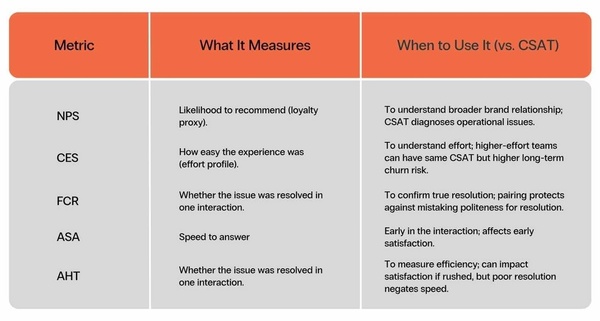
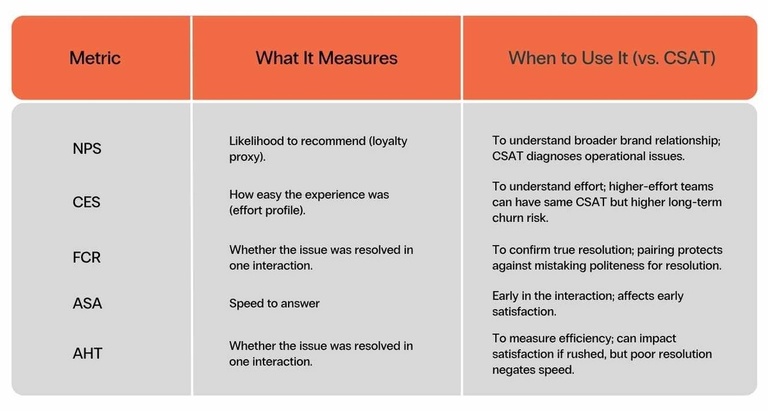
How Acclaim helps improve CSAT
CSAT improves when interactions are accurate, efficient, and powered by outcome-driven AI agents—without customers repeating themselves or getting stuck in handoffs:
- Goal-oriented interaction flows reduce conversational drift and prevent looping
- Stronger intent capture and routing reduces transfers and misroutes
- Context-aware handling reduces repetition and “clarification fatigue”
- Multilingual handling reduces unnecessary handoffs
- Guardrails support consistency in verification, disclosures, and audit-ready steps
- Operational controls let teams refine workflows quickly without long development cycles
Where CSAT gains are often most visible:
- High-volume service interactions with repeatable patterns
- Scheduling and appointment setting
- Payments and recovery interactions with defined policy steps
- Status and next-step calls where clarity and follow-through drive satisfaction
FAQs
What does CSAT stand for?CSAT stands for Customer Satisfaction Score. It measures how satisfied customers are with a specific interaction, transaction, or experience, typically via a short survey.
What is included in CSAT?CSAT usually reflects the customer’s satisfaction rating for a particular touchpoint (for example, a support call or chat). It does not automatically represent long-term loyalty unless your program is designed to measure that.
How do you calculate CSAT?A common method is Top-2 box on a 5-point scale: CSAT (%) = (number of satisfied responses ÷ total responses) × 100. Qualtrics documents this approach (counting 4 and 5 as satisfied).
Is CSAT the same as NPS?No. CSAT measures satisfaction with a specific experience. NPS measures likelihood to recommend and is often used as a broader loyalty indicator.
What is a good CSAT score?There is no universal “good” CSAT. Compare like with like: set targets by workflow type and channel, and track CSAT alongside FCR, transfer rate, and QA/compliance outcomes.
How often should you measure CSAT?Measure CSAT at key touchpoints where you can take action: post-interaction for support, and at meaningful journey milestones for broader experiences. Programs commonly use short automated surveys after the experience to capture point-in-time sentiment.
What are the biggest drivers of CSAT in contact centers?Resolution quality, customer effort (holds, transfers, repetition), agent clarity and tone, and system friction are common drivers. CSAT is typically collected through a simple survey immediately after an interaction.
How can AI improve CSAT in regulated industries?AI can improve CSAT when it reduces effort (fewer holds, fewer transfers), improves resolution consistency, and enforces guardrails for verification, disclosures, and escalation—so speed gains do not introduce compliance risk.
Key takeaways
- CSAT measures satisfaction with a specific experience, usually via a short survey.
- A common CSAT calculation is Top-2 box percent: (satisfied responses ÷ total responses) × 100.
- CSAT is point-in-time; it is not a full loyalty metric and should be paired with NPS and/or CES based on your goal.
- Benchmark CSAT by workflow and channel, not as one global number.
- Improve CSAT by improving resolution and reducing effort: fewer transfers, fewer repeats, better knowledge, and lower friction—especially in payments and recovery workflows.