AI Drift Is Why “Good Conversations” Still Fail In CX
At a glance
- Many AI CX systems are optimized to talk well, not finish work.
- Drift shows up as long, meandering conversations with missing steps, inconsistent handling, or premature/late escalation.
- A goal-oriented approach treats conversations like workflows: clear start, clear done, safe path in between.
AI drift is the failure mode nobody budgets for
Most CX teams assume an AI CX platform’s conversational quality equals operational success. It doesn’t.
You can have an AI that sounds polished and still creates operational damage because it can’t reliably drive an interaction to completion. The “drift” pattern is predictable:
- The customer asks something simple.
- The AI answers something adjacent.
- The conversation expands.
- Required steps get skipped.
- The outcome never happens.
The result is contact without completion.
How drift shows up in real operations
What are the typical symptoms when you don’t use a goal-first framework?
- Long conversations without closure
- Missed required steps or missing key data
- Escalation that happens too early or too late
- Inconsistent experiences across customers
- Unpredictability that makes governance hard
In practice, that means:
- Payments/recovery contacts that don’t end in a payment promise or payment action
- Service calls that don’t end in a verified resolution
- Sales conversations that don’t end in qualification and next-step scheduling
The AI didn’t fail to talk. It failed to execute.
The fix: design conversations like workflows
A goal-oriented approach isn’t “more scripting.” It’s a design discipline:
- Set a destination (the outcome)
- Guide step-by-step toward completion
- Adapt when customers change direction
- Confirm arrival with a clear definition of success
The customer experiences a natural conversation. Operations sees consistent execution.
That “clear start / clear done” structure is what removes drift.It narrows the system’s job from “be generally helpful” to “complete this specific work safely.”
The expensive costs of drift
There are multiple ways AI drift in CX can become costly for an enterprise. First, it can create compliance costs when penalties are assessed for regulatory violations (which also incur reputational costs). Then there’s the cost of consumed resources and infrastructure. At scale, these expenses add up, stealing time and resources away from other customers.
Drift is costly anywhere, but it’s lethal in regulated or high-risk workflows where steps are non-negotiable:
- Identity verification
- Required disclosures
- Eligibility checks
- Offer constraints
- Escalation boundaries
If those are inconsistent, you don’t just lose efficiency. You create compliance exposure and unpredictable customer outcomes.
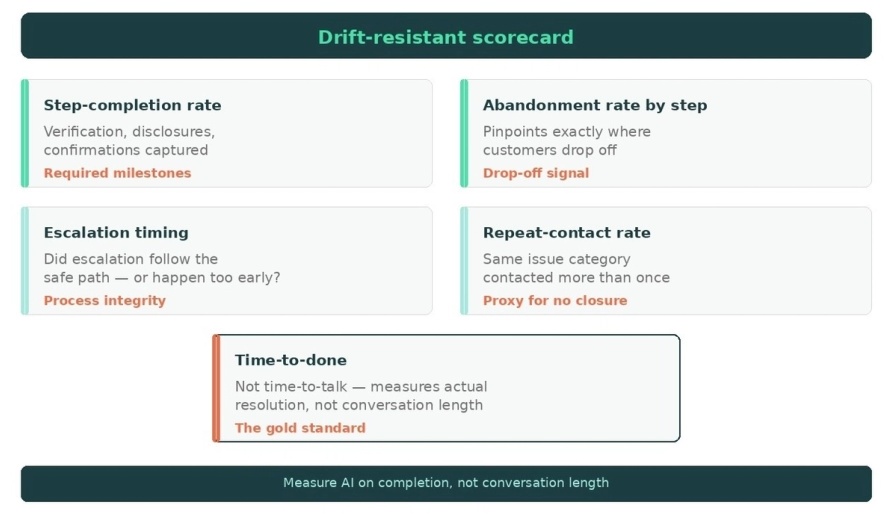
What a drift-resistant scorecard looks like
If you want to prove you’ve killed drift, track metrics that expose it:
What to do next
Treat AI drift like a product bug,nota customer behavior problem.
- Audit transcripts for “no closure” patterns.
- Identify the missed steps that correlate with poor outcomes.
- Redesign the workflow so the AI is measured on completion, not conversation length.
How Acclaim can help
How can you make operational drift by AI a thing of the past? By deploying AI CX agents built from the ground up around a Goal-Oriented Agent Logic (GOAL) framework that drives every conversation toward a measurable outcome.
If you’re ready to kick AI drift to the curb and improve customer experiences, set up a demo!