How to Implement Goal-Driven AI CX Agents: A Practical 90-Day Roadmap
At a glance
- AI CX agent implementation fails when scope gets too broad too fast.
- Start with one defined operational job tied to a measurable business outcome.
- Build guardrails, escalation logic, workflow instrumentation, and ownership before launch.
- Use a 90-day pilot to prove performance, fix workflow issues, and scale from evidence.
Most AI CX initiatives fail for one predictable reason: uncontrolled scope
When the mandate is “replace the contact center,” AI CX projects stall, expand endlessly, or ship something brittle that collapses under real-world complexity.
Successful AI CX agent implementation doesn’t start with transformation. It starts with discipline: define one operational job, tie it to a measurable outcome, build the workflow, instrument it, iterate.
That’s how enterprise AI rollouts actually succeed.
This guide outlines a practical roadmap for implementing an AI agent in 90 days.
Primary focus areas:
- AI agent implementation
- Conversational AI deployment
- CX automation strategy
- Enterprise AI rollout
- Conversational AI best practices
What is an AI agent in CX automation?
An AI agent in customer experience is a goal-oriented system designed to complete a defined business task through structured conversational logic, system integrations, and measurable outcomes.
It’s not a general-purpose chatbot.
In an effective AI CX agent implementation, the system must have:
- A clearly defined job
- Measurable success criteria
- Explicit guardrails
- Escalation logic
- Integrated data access
- Performance instrumentation
If performance can’t be measured against a business objective, the system isn’t operational.
That distinction separates experimental conversational AI from production-grade conversational AI deployment.
Define success and guardrails before building
Most AI agent implementation efforts fail because goals are vague and governance is deferred.
Before building workflow logic, document:
Business outcome definition
- What exactly constitutes success?
- What event marks completion?
- What’s the current baseline performance?
Without baseline data, you can’t prove ROI from your AI agent implementation.
Core operational KPIs
- Completion rate
- Containment rate
- Escalation rate
- Cost per outcome\
Business impact KPIs
- Recovery rate
- Conversion rate
- Revenue per interaction
- Margin impact
Customer experience metrics
- First Contact Resolution (FCR)
- Average Handling Time (AHT)
- Complaint rate
- Customer Effort Score (CES)
Guardrails
- What the agent is allowed to offer
- Maximum flexibility or concessions
- Required disclosures
- Escalation triggers
- Prohibited language
In enterprise AI rollouts, governance isn’t a later compliance review. It’s part of system architecture.
Design an AI worker, not “just a chatbot”
An enterprise conversational AI deployment must be manageable.
Operational visibility should include:
- A written job description
- Transparent workflow logic
- Transcript access
- Outcome-level reporting
- A structured iteration plan
If the system can’t be managed like a new hire — goals, scorecard, coaching plan — it isn’t production-ready.
One of the most overlooked conversational AI best practices is treating the agent as an accountable worker,not a novelty interface.
Common failure modes in AI agent implementation
Understanding predictable failure patterns helps prevent wasted cycles in your enterprise AI rollout.
1. Undefined ownership
No single-threaded accountability across CX, IT, and Operations.
2. Vague success criteria
“Improve experience” isn’t measurable.
3. Over-reliance on model retraining
Workflow defects get misdiagnosed as model quality problems.
4. Escalation blind spots
Agents escalate too often or too late because triggers weren’t clearly defined.
5. Missing instrumentation
No transcript tagging. No step-level analytics. No failure diagnostics.
6. Scope creep
New use cases get added before the first one stabilizes.
Most AI agent implementation failures are operational, not technical.
Example: Payment reminder AI agent workflow
Defined job: Secure a payment commitment within policy limits.
Simplified flow:
- Identity verification
- Confirm balance and due date
- Offer structured repayment options
- Capture commitment date
- Confirm next steps
Escalation triggers:
- Dispute raised
- Hardship request outside policy
- Legal threat
- Emotional distress indicators
KPIs:
- Promise-to-pay rate
- Commitment kept rate
- Escalation rate
- Cost per dollar recovered
If drop-off clusters at Step 3, fix Step 3. Don’t default to retraining the model.
In mature conversational AI deployment, optimization is workflow-driven, not model-driven.
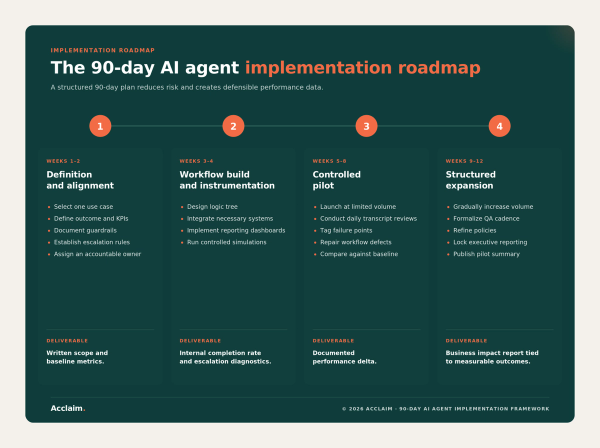
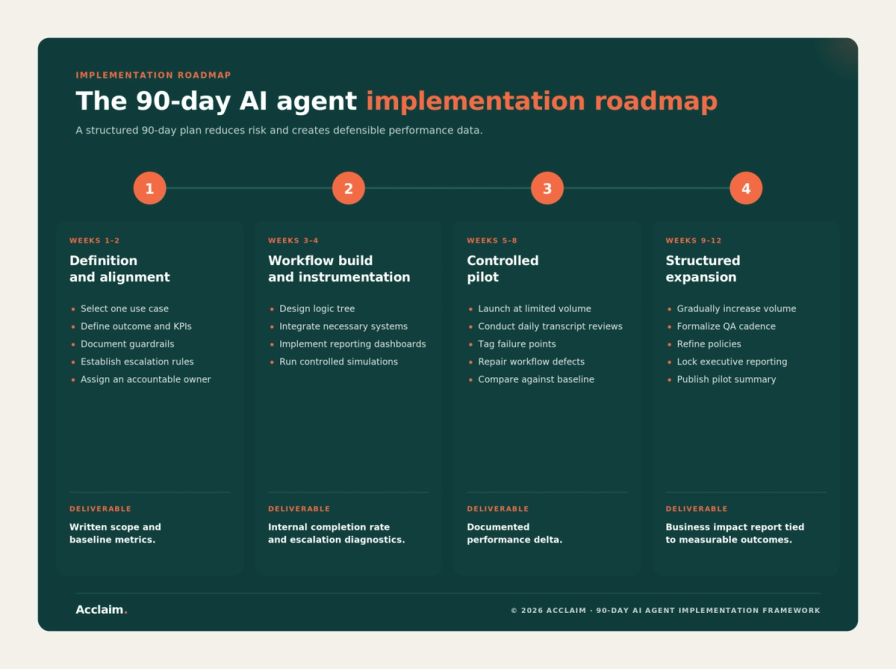
The 90-day AI agent implementation roadmap
A structured 90-day AI implementation plan reduces risk and creates defensible performance data.
Weeks 1–2: Definition and alignment
- Select one use case
- Define outcome and KPIs
- Document guardrails
- Establish escalation rules
- Assign an accountable owner
Deliverable: Written scope and baseline metrics.
Weeks 3–4: Workflow build and instrumentation
- Design logic tree
- Integrate necessary systems
- Implement reporting dashboards
- Run controlled simulations
Deliverable: Internal completion rate and escalation diagnostics.
Weeks 5–8: Controlled pilot
- Launch at limited volume
- Conduct daily transcript reviews
- Tag failure points
- Repair workflow defects
- Compare against baseline
Deliverable: Documented performance delta.
Weeks 9–12: Structured expansion
- Gradually increase volume
- Formalize QA cadence
- Refine policies
- Lock executive reporting
- Publish pilot summary
Deliverable: Business impact report tied to measurable outcomes.
This is what disciplined AI agent implementation looks like in practice.
When to retrain the model vs fix the workflow
Retrain when:
- Speech recognition errors dominate
- Domain vocabulary is misinterpreted
- Intent detection is unstable
Fix workflow when:
- Drop-off clusters at specific steps
- Offer logic is poorly structured
- Escalation triggers are ambiguous
- Policy boundaries are unclear
In most enterprise AI rollouts, performance issues originate in workflow design, not model capability.
FAQs
How long does AI CX agent implementation take?
A tightly scoped use case can move from definition to pilot in 6–12 weeks if ownership is clear and integrations are ready.
What’s a good completion rate?
The right target is improvement over baseline. Absolute numbers vary by industry and use case.
How do you measure AI CX agent performance?
Measure completion rate, escalation rate, containment rate, and cost per outcome — then tie those to revenue, margin, or cost reduction impact.
Should AI replace human agents?
No. A strong CX automation strategy uses AI agents for structured, repeatable workflows so human agents can focus on complex, high-judgment interactions.
What causes most AI CX pilot failures?
Scope inflation, unclear KPIs, weak ownership, and insufficient instrumentation.
What to do next?
If you want fast, defensible proof of AI value:
- Choose one operational job tied to a measurable outcome.
- Document success criteria and guardrails in writing.
- Run a 90-day pilot with transcript-level visibility.
- Review KPI movement weekly against baseline.
Strong AI agent implementation isn’t about ambition.
It’s about disciplined execution.
What Acclaim delivers
Acclaim engineers AI CX agents for specific business outcomes using defined jobs, explicit guardrails, and outcome-based scorecards. This boosts containment and delivers measurable improvements in revenue, resolution rates, cost efficiency, and compliance.
If you’re ready to deploy AI agents proven to deliver successful outcomes, explore how Acclaim can help.